The Weekend Reset

This fits well with our broader theme of recovery as a system reset rather than simply "doing nothing."
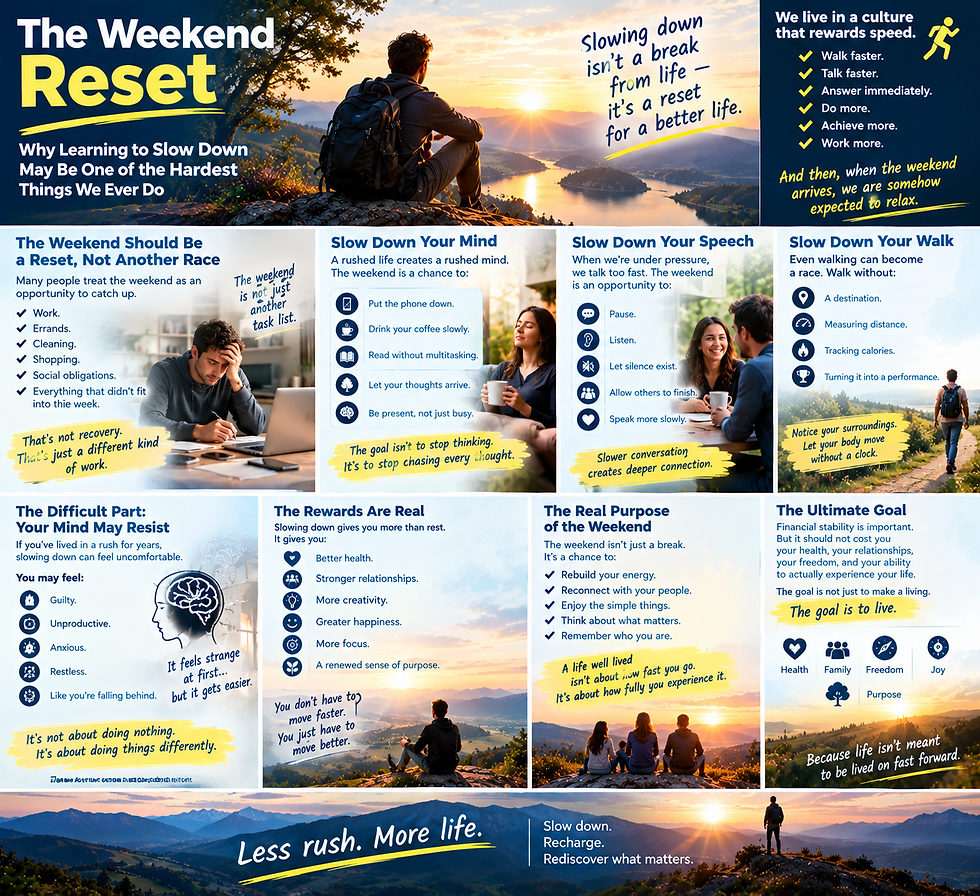
Why Learning to Slow Down May Be One of the Hardest Things We Ever Do
We live in a culture that rewards speed.
Walk faster.
Talk faster.
Answer immediately.
Move from one appointment to another.
Check the phone.
Respond to the message.
Finish the task.
Start the next one.
Work more.
Do more.
Achieve more.
And then, when the weekend arrives, we are somehow expected to relax.
But there is a problem.
If you have lived your entire life in a state of acceleration, you don't simply become calm because Saturday morning arrives.
Your body may be sitting down.
Your mind is still running.
Your feet may have stopped moving.
Your thoughts have not.
Your calendar may be empty.
Your nervous system doesn't know it.
Slowing down is a skill.
And for someone who has spent decades living in a rush, learning that skill can be surprisingly difficult.
The Weekend Should Be a Reset, Not Another Race
Many people treat the weekend as an opportunity to catch up.
Catch up on work.
Catch up on errands.
Catch up on cleaning.
Catch up on shopping.
Catch up on social obligations.
Catch up on everything that couldn't fit into Monday through Friday.
By Sunday night, they are exhausted again.
Then Monday arrives.
And the cycle begins.
That isn't recovery.
That's simply changing the type of work.
A real weekend reset requires something deeper.
It requires giving the mind, body, and emotional system permission to operate at a different speed.
Not necessarily doing nothing.
Doing things differently.
Slow Down Your Mind
The first reset is mental.
A rushed life creates a rushed mind.
You begin jumping from thought to thought without completing any of them.
You think about tomorrow while eating today.
You answer one message while thinking about another.
You watch television while looking at your phone.
You have a conversation while mentally preparing for the next appointment.
Eventually, stillness can feel uncomfortable.
This is one of the great paradoxes of modern life:
We become so accustomed to stimulation that peace begins to feel like boredom.
The weekend should provide an opportunity to reverse that.
Sit somewhere without immediately reaching for your phone.
Drink your coffee slowly.
Look outside.
Read something without multitasking.
Take a walk without turning it into exercise.
Let your thoughts arrive without immediately acting on them.
The objective isn't to stop thinking.
It is to stop chasing every thought.
Slow Down Your Speech
There is another form of rushing that we rarely notice:
the speed at which we talk.
When people are constantly under pressure, their speech often accelerates.
They interrupt.
They finish other people's sentences.
They answer before the other person has finished speaking.
They move rapidly from one subject to another.
Conversation becomes another productivity exercise.
The weekend offers an opportunity to practice something different.
Pause.
Listen.
Let silence exist.
Don't immediately fill every space.
Allow another person to finish.
Think before answering.
Speak more slowly.
You may discover something surprising:
Slower conversation creates deeper conversation.
When people aren't racing to the next sentence, they have more room to actually hear one another.
And relationships need that space.
Slow Down Your Walk
Even walking can become an expression of urgency.
We walk quickly because we are going somewhere.
Then we walk quickly because we have become accustomed to walking quickly.
The destination becomes more important than the journey.
A weekend walk can reverse this.
Walk without a destination.
Walk without measuring distance.
Walk without trying to maximize calories.
Walk without turning it into another performance metric.
Look around.
Notice trees.
Notice buildings.
Notice people.
Notice the sky.
Notice your surroundings.
Let your body remember what it feels like to move without being chased by a clock.
Sometimes the fastest way to recover is to stop trying to accomplish something.
The Difficult Part: Your Mind May Resist
This is where the idea becomes much harder than it sounds.
Someone who has lived in a rush for twenty or thirty years may discover that slowing down initially feels wrong.
They may feel guilty.
They may feel unproductive.
They may become restless.
They may suddenly remember ten things they should be doing.
They may say:
"I can't just sit here."
Exactly.
That reaction is part of the problem.
If your mind cannot tolerate an hour without productivity, you don't necessarily have more discipline than everyone else.
You may simply have trained yourself to remain activated.
The solution is not to criticize yourself.
The solution is to practice.
Recovery Is Not Laziness
One of the most damaging ideas in modern culture is that rest must be earned.
We work hard, therefore we deserve to rest.
We finish everything, therefore we can relax.
We accomplish enough, therefore we can take a break.
But there is a problem with that philosophy:
Everything is never finished.
There will always be another email.
Another bill.
Another project.
Another repair.
Another meeting.
Another responsibility.
If you require completion before allowing yourself to recover, you may never recover.
Rest is not the reward for finishing life.
Rest is part of living life.
The Body Needs a Different Rhythm
The human body is not designed to operate at maximum intensity indefinitely.
Periods of activity need periods of recovery.
Periods of concentration need periods of mental space.
Periods of social stimulation need periods of quiet.
Periods of work need periods when work is deliberately removed from the environment.
The weekend can provide that change in rhythm.
Not because Saturday and Sunday possess magical properties.
Because humans need cycles.
Activity.
Recovery.
Activity.
Recovery.
The problem occurs when activity becomes continuous.
The Weekend Should Feel Different
A good weekend should not necessarily look like a five-day workweek with different clothes.
The rhythm should change.
Wake up without immediately checking messages.
Eat without rushing.
Talk without looking at the clock.
Walk without a destination.
Spend time with people without simultaneously managing something else.
Allow empty periods to exist.
Perhaps do something completely unnecessary.
That last one may be particularly important.
Do something that produces no measurable result.
Sit outside.
Listen to music.
Watch the sunset.
Take a long walk.
Have coffee with someone.
Read a book.
Play with your children.
Look at the water.
Do nothing.
The modern mind desperately needs experiences that cannot be converted into productivity statistics.
You May Have to Relearn How to Be Bored
Boredom has almost disappeared.
The moment there is nothing happening, we reach for a phone.
Waiting in line?
Phone.
Waiting for food?
Phone.
Sitting in a car?
Phone.
Waiting for someone?
Phone.
The five empty minutes that once belonged to our minds have become opportunities for additional stimulation.
But boredom has a hidden benefit.
It gives the mind room.
When nothing is demanding your attention, thoughts can wander.
Ideas connect.
Memories surface.
Problems become clearer.
Creativity appears.
Intuition has space.
A constantly occupied mind has very little room to hear itself.
The Weekend Can Become a Laboratory for Slowness
You don't have to transform your entire life overnight.
Start with the weekend.
Create deliberate periods of reduced speed.
For example:
Slow mind: Spend part of the morning without news, email, or social media.
Slow speech: Have at least one conversation where you deliberately listen more than you speak.
Slow walking: Take a walk without tracking distance, speed, or calories.
Slow eating: Eat without screens and without rushing.
Slow transitions: Don't immediately fill the space between activities.
Slow evening: Allow the final hours of the day to become quieter.
These small practices teach the nervous system something important:
There is no emergency right now.
Don't Turn Recovery Into Another Project
There is another trap.
We can become so obsessed with optimization that we turn relaxation into another performance.
Now we need the perfect recovery schedule.
The perfect meditation.
The perfect sleep routine.
The perfect weekend diet.
The perfect exercise program.
The perfect morning ritual.
Suddenly relaxation has become another assignment.
Don't do that.
The purpose is not to become the world's most efficient person at recovering.
The purpose is to recover.
There is a difference.
The First Weekends May Feel Uncomfortable
If you have been living in a rush for decades, don't expect the first slow weekend to feel wonderful.
It might feel strange.
You might feel guilty.
You might become impatient.
You might find yourself reaching for your phone every few minutes.
You may suddenly notice how exhausted you actually are.
That doesn't mean the experiment failed.
It may mean that you are finally noticing what constant acceleration was hiding.
Give yourself time.
A lifetime of rushing cannot be reversed in one weekend.
But one weekend can begin the process.
Children Need to See Adults Slow Down
There is another reason this matters.
Children learn from what adults demonstrate.
If they constantly see adults rushing, checking phones, multitasking, interrupting, working, and complaining about being busy, they learn that this is what adulthood looks like.
But imagine children seeing something different.
Mom and Dad sitting together.
A slow breakfast.
A long walk.
A conversation without phones.
A family meal without rushing.
An afternoon where nobody has to accomplish anything.
Children learn something powerful:
Life isn't always an emergency.
That may be one of the greatest lessons we can give them.
Slowing Down Can Improve How We Relate to Others
Rushing doesn't only affect our relationship with ourselves.
It affects everyone around us.
A rushed person can become impatient.
A rushed parent can become short-tempered.
A rushed partner can become emotionally unavailable.
A rushed friend can become distracted.
A rushed conversation becomes superficial.
When we slow down, we create room for other people.
We notice facial expressions.
We hear tone.
We recognize hesitation.
We ask better questions.
We become more present.
Presence is one of the greatest gifts we can give another person.
And presence requires time.
The Weekend Is Not About Doing Less
It is about being more present while doing what you do.
You can cook.
But cook slowly.
You can exercise.
But don't turn every movement into a competition.
You can see friends.
But actually be with them.
You can travel.
But look out the window.
You can go shopping.
But don't make the entire day another race.
You can work on a project.
But leave enough space around it to breathe.
The goal isn't inactivity.
The goal is lower intensity.
A Person Who Has Forgotten How to Slow Down Has Not Lost the Ability
This is perhaps the most hopeful part.
The ability to slow down is not gone.
It is simply underused.
Just as we train ourselves to move quickly, we can train ourselves to move slowly.
Just as we train ourselves to respond immediately, we can train ourselves to pause.
Just as we train ourselves to fill every empty moment, we can learn to leave some moments empty.
The first few attempts may feel unnatural.
Eventually, they begin to feel normal.
Then something interesting happens.
You begin taking some of that slower rhythm into Monday.
Then Tuesday.
Then Wednesday.
And suddenly the weekend is no longer the only time you recover.
You have begun changing the architecture of your life.
The Greatest Luxury May Be Time Without Urgency
We often associate luxury with expensive things.
Cars.
Homes.
Hotels.
Watches.
Restaurants.
But there is another form of luxury that cannot be purchased easily:
time without urgency.
Time to think.
Time to walk.
Time to listen.
Time to eat.
Time to talk.
Time to sit.
Time to look around.
Time to do absolutely nothing.
A person can have enormous financial resources and still live in permanent urgency.
Another person can have far less and experience extraordinary moments of peace.
The difference isn't always money.
Sometimes it is the ability to slow down.
The Weekend Reset
Perhaps we should stop asking:
"What am I going to accomplish this weekend?"
And occasionally ask:
"What am I going to recover this weekend?"
Recover your attention.
Recover your patience.
Recover your curiosity.
Recover your relationships.
Recover your ability to listen.
Recover your ability to enjoy ordinary things.
Recover your ability to walk without rushing.
Recover your ability to sit without guilt.
Recover your ability to think without interruption.
Recover yourself.
Because the purpose of the weekend isn't simply to prepare you to work another five days.
It is to remind you that you are more than the work you do.
And if you have spent decades living at full speed, don't be surprised if slowing down feels difficult.
It is difficult because you are not simply changing your schedule.
You are changing your internal speed.
Start slowly.
One conversation.
One meal.
One walk.
One quiet morning.
One phone-free hour.
One weekend at a time.
Eventually, you may discover something that was there all along:
Life becomes much larger when you stop rushing through it.
Leonardo Mora
CEO of Vision
GAWK Corporation


Comments