Why Is It So Difficult for Homeless People to Find a Job and Become Fully Functional?

There is a question we often ask about homelessness that sounds simple but hides an enormous assumption:
Why don't homeless people just get a job?
At first glance, employment appears to be one of the most obvious solutions to homelessness. Get a job, earn money, rent a room or apartment, establish stability, and begin rebuilding life.
But this logic reverses the actual sequence of events for many people experiencing homelessness.
A person cannot always move from homelessness → employment → stability.
Often, the real sequence must be:
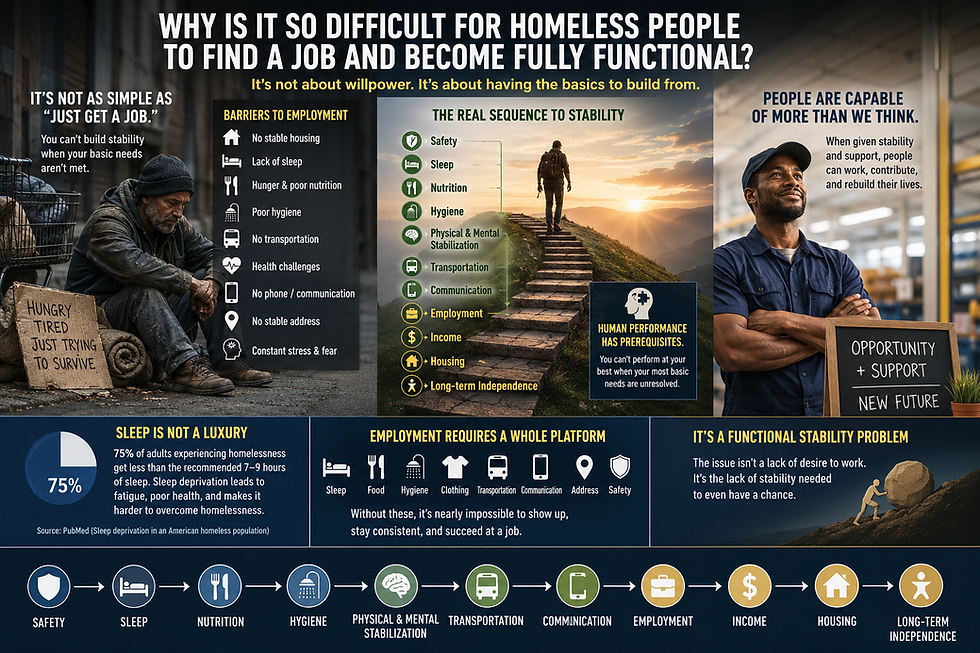
Safety → sleep → nutrition → hygiene → physical and mental stabilization → transportation → communication → employment → income → housing → long-term independence.
Expecting someone to perform at their best in the labor market while they are hungry, exhausted, exposed to danger, unable to shower, uncertain where they will sleep tonight, and constantly worried about their next meal is asking the person to solve a complex problem while their most basic biological needs remain unresolved.
This is not an argument that homeless people are incapable of working. Quite the opposite.
It is an argument that human performance has prerequisites.
Research supports this idea. A U.S. Department of Health and Human Services review describes homelessness as creating multiple employment barriers, including lack of housing and financial resources, transportation problems, health challenges, and difficulties maintaining the conditions necessary for employment. It specifically notes that personal cleanliness, appropriate clothing, punctuality, and the energy required to meet job expectations can all become difficult under unstable living conditions. (ASPE)
The problem, therefore, is much deeper than unemployment.
It is a functional stability problem.
1. Employment Requires More Than Willpower
Modern employment assumes that a person can consistently perform a surprisingly complicated set of tasks.
You need to wake up at a predictable time.
You need to know where you are going.
You need transportation.
You need appropriate clothing.
You need to be reasonably clean.
You need enough energy to work.
You need to concentrate.
You need to communicate with supervisors and coworkers.
You need to arrive on time.
You need to maintain a phone or another communication channel.
You need somewhere to store your belongings.
You need to eat.
You need to sleep.
You need to recover from the previous workday so that you can repeat the process tomorrow.
For someone with stable housing, these requirements are mostly invisible because the infrastructure of everyday life is already there.
The bedroom provides sleep.
The refrigerator provides food.
The bathroom provides hygiene.
The closet provides clothing.
The home provides a place for belongings.
The address provides an identity and point of contact.
The car or public transportation provides mobility.
The home becomes a platform for employment.
For someone experiencing homelessness, that platform may not exist.
And that changes everything.
2. Sleep Is Not a Luxury
One of the most underestimated components of employment readiness is sleep.
Imagine being told:
"Tomorrow morning, be at work at 7:00 AM, energetic, focused, clean, patient, productive and emotionally stable."
Now imagine that you spent the previous night sleeping in a place where you could not fully relax.
Perhaps there was noise.
Perhaps you were worried about theft.
Perhaps you were exposed to cold, heat or rain.
Perhaps you had to move.
Perhaps you were sharing a crowded shelter.
Perhaps you were sleeping outdoors.
Perhaps you were simply afraid.
Then imagine repeating the experience every night.
This is not merely uncomfortable.
It affects functioning.
A study of adults experiencing homelessness found that 75% of participants reported getting less than the recommended 7–9 hours of sleep. Participants also showed substantially greater fatigue and sleep disturbance than the general population. The researchers concluded that sleep deprivation can be a barrier to overcoming homelessness. (PubMed)
Another study involving 404 adults experiencing homelessness found that shorter sleep and inadequate sleep were associated with poorer self-rated health and more days of poor physical and mental health. The researchers specifically pointed toward the importance of safe environments where people can sleep comfortably and without interruption. (PubMed Central (PMC))
This creates an enormous employment problem.
A worker who has slept badly once can still function.
A worker who sleeps badly night after night may struggle with:
concentration
memory
emotional regulation
energy
punctuality
physical endurance
decision-making
patience
social interaction
And employment is fundamentally a repeated-performance system.
The employer doesn't need you to function well once.
The employer needs you to function well Monday through Friday, week after week.
3. Hunger Changes the Equation
The second fundamental issue is nutrition.
It is important to distinguish between having something to eat and having reliable access to adequate nutrition.
A person might receive a meal today.
That does not necessarily mean they have a dependable food system.
People experiencing homelessness may lack:
refrigeration
cooking equipment
food storage
transportation to grocery stores
money for healthy food
predictable meal schedules
control over what food is available
Recent U.S. research found that approximately 57% of people experiencing housing insecurity or homelessness were food insecure across the studies included in a meta-analysis, with an estimated 63% among people experiencing homelessness specifically. (PubMed)
That is an enormous number.
And food insecurity is not simply the sensation of being hungry.
It is uncertainty about whether adequate food will be available.
One study of homeless adults found that food insufficiency was associated with substantially greater odds of hospitalization and high emergency-department utilization. (PubMed Central (PMC))
Other research describes the practical problem directly: people experiencing unsheltered homelessness may rely on donated or inexpensive foods that do not necessarily satisfy nutritional needs and may worsen existing health problems. (PubMed Central (PMC))
This matters for employment.
Consider the difference between:
Breakfast: eggs, fruit, whole grains, yogurt and water.
versus
Breakfast: whatever inexpensive or donated food happens to be available.
The issue isn't that inexpensive food is inherently bad.
The issue is consistency, adequacy and nutritional quality.
A person attempting physically or mentally demanding work needs reliable fuel.
4. The Brain Needs Stability Too
There is another dimension that is easy to miss.
Homelessness forces the brain to spend enormous amounts of attention on immediate survival.
Where will I sleep?
Where can I shower?
Where will my next meal come from?
Where can I charge my phone?
Where are my belongings?
Will someone steal them?
Can I stay here?
How do I get to work?
Where can I use a bathroom?
What happens if I lose this job?
What happens if I get sick?
These are not abstract philosophical questions.
They consume cognitive bandwidth.
A person living in a stable home can dedicate a large proportion of mental capacity to work, education, relationships, creativity and long-term planning.
A person living in constant uncertainty may be forced to dedicate much more attention to today.
This produces an important distinction:
Long-term planning is difficult when the present is unstable.
And employment requires both.
5. Hygiene Becomes an Employment Problem
Imagine going to a job interview without having showered for several days.
Imagine wearing the same clothing repeatedly because you have nowhere to wash it.
Imagine having nowhere to safely store clean clothes.
Imagine not having access to a bathroom before work.
These circumstances can affect how an applicant is perceived.
This is especially important because hiring decisions often happen within minutes.
The employer may interpret visible signs of homelessness as:
lack of responsibility
poor motivation
poor hygiene
unreliability
lack of professionalism
But the underlying reality may be completely different.
The person may be highly motivated.
They may simply lack the infrastructure required to display that motivation.
HHS research has explicitly identified personal cleanliness, appropriate clothing, punctuality and energy as conditions that can be difficult to maintain under homelessness. (ASPE)
That creates a tragic feedback loop:
Homelessness makes professional presentation harder → professional presentation affects employability → difficulty finding employment prolongs homelessness.
6. Transportation Can Destroy an Otherwise Good Job
Suppose someone finds a job.
That should solve the problem, right?
Not necessarily.
Now the person has to get there.
If the job begins at 6:00 AM, perhaps public transportation doesn't operate early enough.
If the job is in another part of the city, multiple transfers may be necessary.
If one bus is late, the employee is late.
If the employee is late repeatedly, the employer may eventually terminate them.
Research on employment barriers consistently identifies transportation as a significant structural obstacle, particularly when jobs are located away from where people can realistically access them. (ASPE)
The paradox is remarkable:
A person can be willing to work and still be unable to reliably reach work.
7. The Address Problem
Modern society assumes that everyone has an address.
Job applications may ask for one.
Government programs may require one.
Banks may require one.
Employers may need a mailing address.
Important documents need somewhere to go.
A person without stable housing therefore faces an administrative problem before they even reach the workplace.
HHS has specifically identified the lack of housing and telephone access as employment barriers, including difficulties with job applications and communication. (ASPE)
Today, we could add another layer:
digital connectivity.
Many jobs require:
email
online applications
text communication
digital scheduling
online training
electronic documents
video interviews
authentication systems
Someone without a reliable phone, computer, internet connection or charging location is competing in a labor market that assumes constant digital access.
8. Employment Can Become Another Source of Instability
There is a critical insight here:
Getting a job is not the same as becoming employable long-term.
Suppose someone gets a low-wage job.
They now have transportation costs.
They need food.
They need work clothes.
They need a phone.
They may need laundry.
They may need childcare.
They may need to maintain access to shelter.
They may have medical expenses.
They may still be sleeping poorly.
Their first paycheck may not arrive for two weeks.
So the person can become employed while remaining extraordinarily vulnerable.
One missed shift can matter.
One illness can matter.
One lost phone can matter.
One transportation failure can matter.
One unexpected expense can matter.
A person living with financial reserves can absorb these shocks.
A person living at the edge cannot.
This is why employment stability is more important than simply measuring whether someone has a job.
9. The Homelessness Trap
All of these factors can form a circular system:
No housing
↓
Poor sleep
↓
Fatigue
↓
Reduced concentration and physical capacity
↓
Difficulty obtaining or maintaining employment
↓
Low or no income
↓
Inability to secure stable housing
↓
Continued homelessness
↓
Poor nutrition and chronic stress
↓
Worsening health
↓
Even greater difficulty maintaining employment
↓
Back to homelessness
This is a negative feedback loop.
And negative feedback loops are difficult to escape because every problem reinforces another problem.
Research on long-term homelessness describes a similar cycle in which persistent housing instability can impede access to health and employment services while health and economic challenges simultaneously make stabilization more difficult. (ASPE)
10. We Often Ask the Wrong Question
The traditional question is:
"Why doesn't this person get a job?"
A better question is:
"What conditions does this person need in order to successfully obtain and maintain a job?"
That shift is enormous.
Instead of treating employment as the starting point, we recognize employment as an outcome of functional stability.
This does not mean lowering expectations.
It means creating the conditions under which expectations become achievable.
11. Housing Is Not the Reward for Employment
One of the most important conceptual changes would be to stop thinking:
Get a job → earn housing.
For many people experiencing homelessness, the sequence may need to be:
Provide stability → restore functioning → support employment → increase income → sustain housing.
This does not mean giving people everything indefinitely.
It means understanding that housing can be productive infrastructure.
A room is not merely a place to sleep.
It is also:
a recovery environment
a place to store food
a place to maintain hygiene
a place to keep clothing
a place to charge a phone
a place to complete applications
a place to receive mail
a place to sleep before work
a place to decompress after work
In other words:
Housing is an employment-support technology.
12. Nutrition Should Be Considered Part of Employment Infrastructure
If we genuinely want people to become economically independent, food programs should not be designed merely around eliminating hunger.
They should also consider functionality.
A good nutritional support system could provide:
predictable meals
adequate protein
fruits and vegetables
whole grains
hydration
appropriate calories
medically appropriate options when necessary
access to cooking and food storage
Research on homelessness and diet identifies financial barriers and lack of cooking and storage facilities as important obstacles to healthy eating, with frequent consumption of energy-dense, nutrient-poor foods reported in one qualitative study. (PubMed Central (PMC))
The objective should therefore move from:
"Did this person eat?"
to:
"Is this person's nutritional environment sufficient to support health, cognition and daily functioning?"
13. Sleep Should Be Treated as a Public Health Intervention
Imagine a homelessness program that includes a quiet, secure sleeping environment.
People can sleep uninterrupted.
They can wake up at a predictable time.
They can shower.
They can eat breakfast.
They can put on clean clothes.
They can charge their phone.
They can travel to work.
That person walks into an interview as a fundamentally different candidate.
Not because their personality changed.
Not because their intelligence changed.
Not because their motivation suddenly appeared.
Their environment changed.
Research specifically supports the importance of safe sleeping environments for physical and mental health among people experiencing homelessness. (PubMed Central (PMC))
14. The Goal Should Be Functional Independence
The ultimate objective should not be to create permanent dependency.
It should be to create a bridge from instability to independence.
That bridge might look like:
Stage 1 — Survival
Food, water, safety and emergency medical care.
Stage 2 — Stabilization
Safe sleeping environment, hygiene, clothing and secure storage.
Stage 3 — Functional Recovery
Nutrition, sleep, healthcare, mental-health support where needed and daily routines.
Stage 4 — Employment Preparation
Identification, phone access, transportation, resume preparation, interview preparation and skills training.
Stage 5 — Employment
Job placement with realistic scheduling and transportation.
Stage 6 — Employment Retention
Continued support during the vulnerable first months of employment.
Stage 7 — Housing
Stable, affordable housing supported by sustainable income.
Stage 8 — Independence
Savings, career development, improved employment and reduced dependence on emergency systems.
This is much more sophisticated than simply saying:
"Get a job."
15. We Should Measure the Right Things
If society wants to determine whether homelessness programs are working, we should measure more than the number of people placed into jobs.
We should measure:
Sleep stability
Can the person consistently sleep safely?
Nutrition
Can the person reliably obtain adequate food?
Hygiene
Can the person shower and maintain clean clothing?
Transportation
Can the person reliably reach work?
Communication
Does the person have a functioning phone and reliable communication?
Health
Can the person physically and mentally perform daily activities?
Employment
Did they obtain a job?
Employment retention
Did they remain employed for 30, 90 and 180 days?
Income
Is their income increasing?
Housing
Did they transition into stable housing?
Independence
Are they progressively requiring fewer emergency interventions?
These measures tell us much more about whether a person is actually rebuilding a life.
16. Compassion and Accountability Are Not Opposites
There is sometimes a false choice between compassion and personal responsibility.
We don't have to choose.
A person can be responsible for their decisions while society recognizes that human beings require basic conditions to function.
We expect soldiers to sleep.
We expect athletes to eat properly.
We expect children to have safe environments in which to learn.
We expect employees to have transportation.
We expect executives to have offices.
We expect students to have classrooms.
Why would we expect someone experiencing homelessness to perform at maximum capacity while denying them the basic infrastructure required for human performance?
Accountability works better when people have the capacity to meet the expectations placed upon them.
17. The Deeper Lesson
Perhaps the most important lesson is that homelessness should not be viewed simply as the absence of a house.
It is frequently the absence of an entire functional ecosystem.
A home connects many systems together:
Sleep + nutrition + hygiene + safety + identity + storage + communication + transportation + privacy + recovery.
Remove the home, and all of those systems can become fragmented.
That fragmentation makes employment harder.
Employment then becomes harder to sustain.
And without employment, housing becomes harder to obtain.
That is why the problem can appear so stubborn.
We are trying to solve one part of a system while leaving the other parts broken.
18. From Charity to Human Infrastructure
The future of homelessness policy should therefore move beyond the idea of simply providing emergency relief.
Food is important.
Shelter is important.
Clothing is important.
But the ultimate objective should be restoring human functionality.
The question should become:
What does a human being need in order to reliably function, work, learn, create, make decisions and build a future?
The answer includes much more than money.
It includes sleep.
Nutrition.
Safety.
Health.
Human connection.
Predictability.
Transportation.
Communication.
Dignity.
Opportunity.
And eventually, meaningful work.
The evidence does not support the idea that homeless people are inherently unwilling or unable to work. HHS's review notes that people experiencing homelessness have demonstrated a desire and capacity to work when opportunity, training and sustained support are available. (ASPE)
The challenge is often that we ask people to demonstrate the final stage of stability before providing enough of the conditions necessary to achieve it.
Conclusion: Before We Ask Someone to Work, We Must Help Them Become Functional
A job can change a person's life.
But a job is not a magic switch.
Someone who is hungry, exhausted, unsafe and constantly worried about where they will sleep tonight is being asked to perform an extraordinarily difficult task: build a future while fighting to survive the present.
That is why homelessness can become so persistent.
The solution is not simply to lower expectations.
It is to build a pathway toward meeting them.
Give someone a safe place to sleep.
Give them access to nutritious food.
Give them the ability to shower and maintain clean clothing.
Give them somewhere to store their belongings.
Give them transportation.
Give them communication.
Give them access to healthcare and appropriate support.
Then ask them to work.
Now the equation changes.
The person is no longer trying to build a future from the middle of a survival crisis.
They have a platform.
And from that platform, employment can become more than a temporary paycheck.
It can become the beginning of stability, dignity, independence and a new trajectory in life.
The central insight is simple:
We should not ask people to achieve stability before giving them the conditions necessary to become stable.
Human functionality is not produced by willpower alone. It emerges from the interaction between the individual and the environment.
If we want people to work, we should build environments in which they can sleep.
If we want them to think clearly, we should help them eat.
If we want them to be reliable, we should help make their lives predictable.
If we want them to become independent, we should first provide a bridge from survival to functionality.
And if we truly want to reduce homelessness, perhaps the most productive question is not:
"Why doesn't this person work?"
but:
"What is preventing this person from functioning—and what can we do to remove those barriers?"
That question moves the conversation from judgment to systems thinking, and from temporary assistance toward genuine human recovery and economic independence.


Comments